

Today I am taking part in a Japanese cooking lesson. As a food lover I wanted to get deeper into the local food scene. But first some basic introductions.
If you want to understand what is the diet of a foreign country , the best way is simply to go and explore a local supermarket. It’s always a very interesting experience because you get into the “food” aspect of that culture. And we know how food is important to shape cultures. Food is what gives us this so precious energy to create. What type of food do they eat in Japan ?
When you first open the door of a Japanese supermarket , it may feel quite chaotic because it’s impossible to read the “Kanji” (the old Chinese characters) therefore you just don’t know what’s in front of your eyes. In a way it’s quite fascinating because you come to realize that you are not “Home” anymore. The language is different , the food is different, the currency is too and so the culture. After 1 month in Tokyo I have shopped several times in supermarkets. It’s way cheaper to do so on the long run than just eating outside all the time. And it’s great to try out new ingredients.
Let me show you some Japanese food.
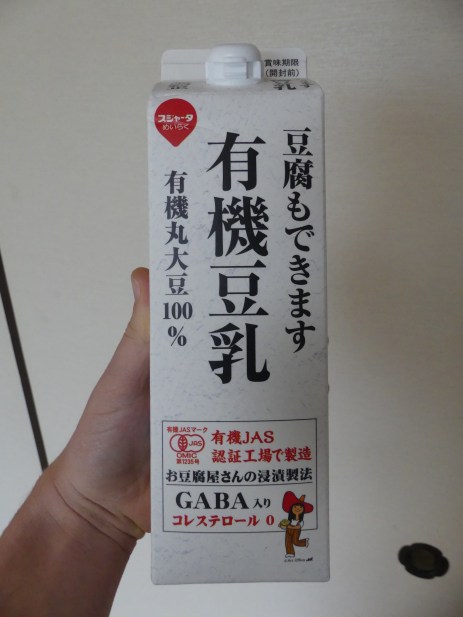
Soy milk. I was curious to try this one. We do have soy milk in France but it didn’t had a lot of taste but this one was quite different. The taste was strong and it actually felt “healthy”. The little “JAS” on the bottle means that it is organic.
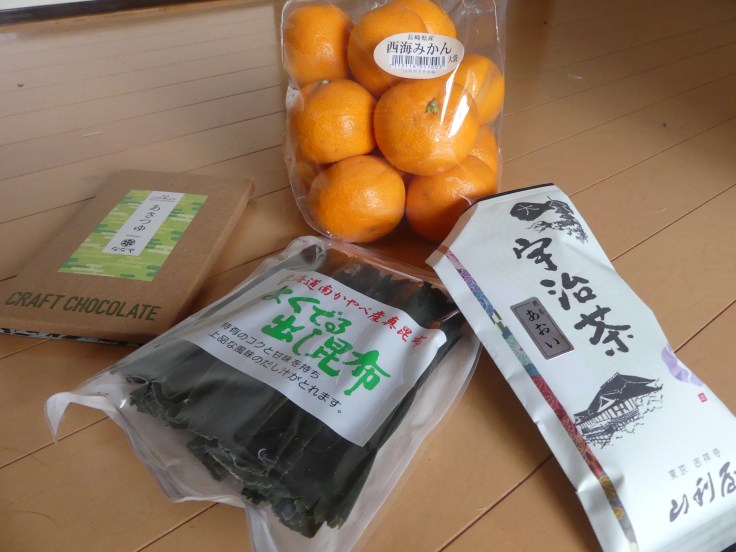 Green tea chocolate , konbu seaweed , Sencha green tea and Tangerines.
This would be a good introduction to the Japanese food scene.
Green tea is everywhere and has been cultivated for a long time. Japanese Green tea is just like French wine. It’s a masterwork that tooked a long time to evolve into what it is today. Drinking Green tea in Japan is a way to connect with a long unspoken history.
Konbu is a seaweed that is used to make “Dashi” , the famous broth used in Ramen , Miso soup … I use it to make vegetarian ramen.
And the “Mikan” or Tangerines are also popular here but usually grow in the southern areas of Japan. They are tasty and are some of the rare affordable Fruits in Japan. Most Fruits will cost you a lot of money (apples , melons , strawberries..) therefore is most commonly used as gifts for friends or family. It is normal to see a fruit decorated in a colorful box with a high price tag in Japan.
I have a Vegetarian cooking lesson not far away from my home. Today we will make Gyozas (dumplings) and Ramen ! I have found this class using the website “Air Kitchen” which I recommend. In fact this platform is a great way to find cooking lessons that suits your own preferences. You can tick some boxes for options which I did. I ended up finding Nahako Vegetarian cooking class in Kunitachi (west of Tokyo). Let’s go.
First we will make the Gyozas.

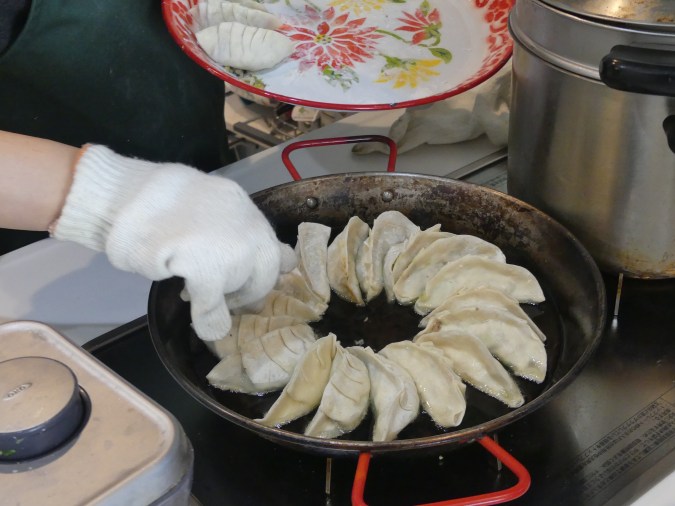
And we fry pan the Gyozas.
Inside theses dimplings we putted some smashed tofu , shiitake mushrooms , chopped garlic / ginger and soy sauce. It was great to learn all the right steps and gestures to makes theses. Japanese people will often eat Gyozas in Izakaya’s after work with some alcool. It’s rare to find Vegetarian Gyozas in Japan , that’s also why I wanted to learn.
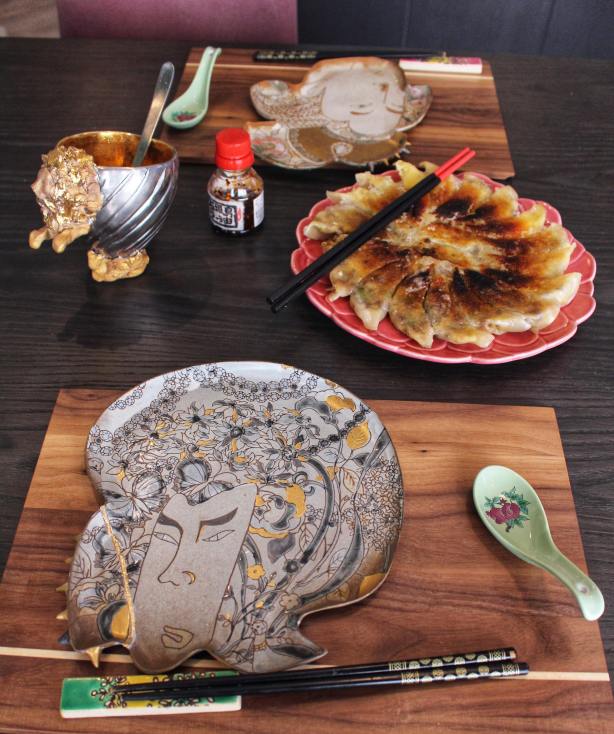
And we eat the Gyozas ! Needless to say it was incredibly tasty.
My teacher for today’s class , Nahako was so sweet. I was the only one taking the class today and she still accepted me. Cooking with her felt like being with a friend , it was nice and also very casual. We actually shared a lot about our own culture and I felt I understood a bit more the complexity of the Japanese society and the human relationships.
“Air Kitchen” is a private website where you cook in people’s home , it’s a good experience to meet local people in an authentic setup (like Airbnb).
After eating many Gyozas it was time to start our Ramen ! First we will make Noodles from scratch.

Noodle making at work. We used an Italian pasta machine which is rather unusual but works well.
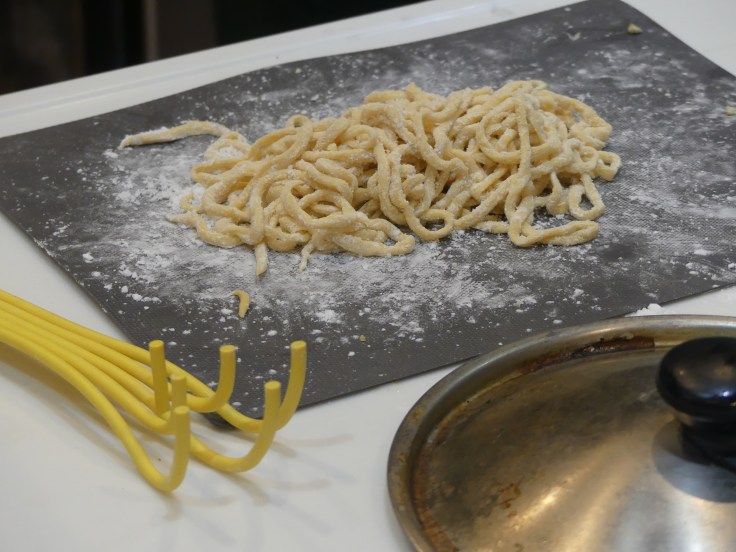
Nice noodles for our ramen made for wheat flour.
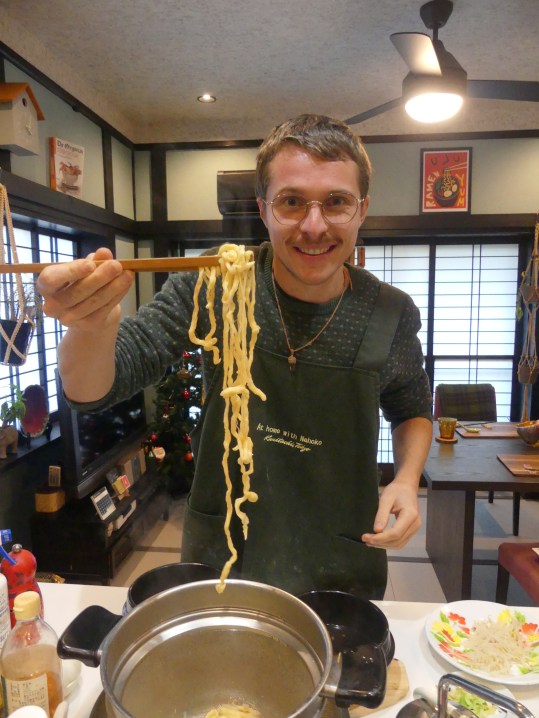
After just 40 seconds in boiling water this is ready !
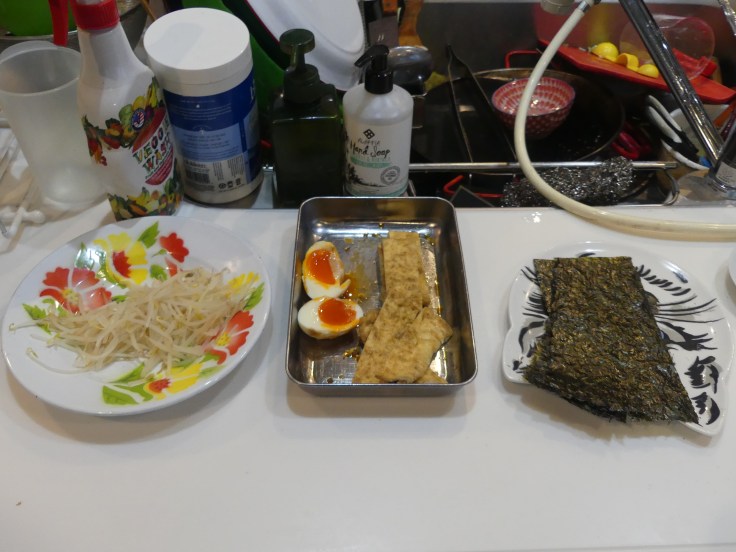 Toppings for our ramen : soy shoots , egg , Age Tofu and Wakame seaweed.
I forget to talk about the most important ingredient of Ramen which is the Broth. Usually it’s made of Pork , Chicken or fish. Because this was a Vegetarian recipe we soaked some Konbu seaweed overnight and used Ginger , green onions and soy sauce for flavors. The Veggie broth was very nice to taste. Less heavy on the stomach than the classic ones.
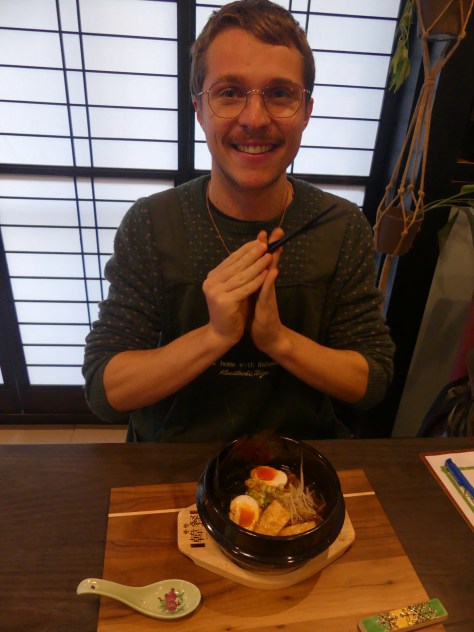
Itadakimasu !
And for dessert , a fusion food , Avocado Yokan. A special creation of our host , Nahako.
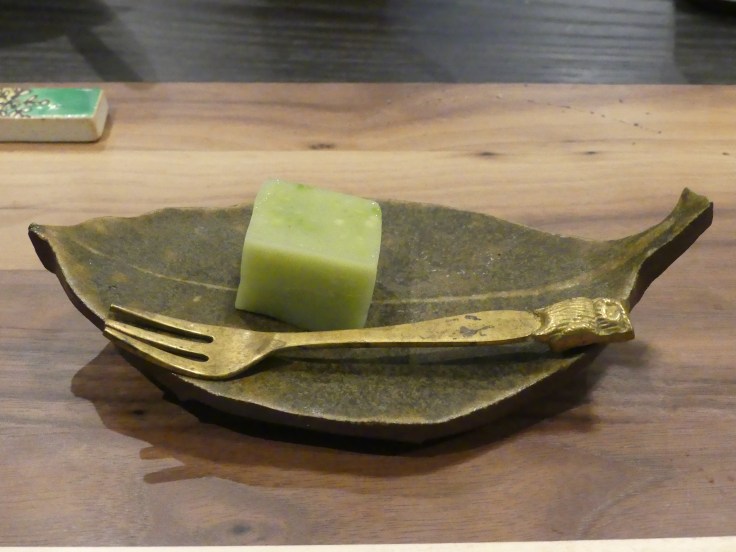 Oishikatta ! Delicious.
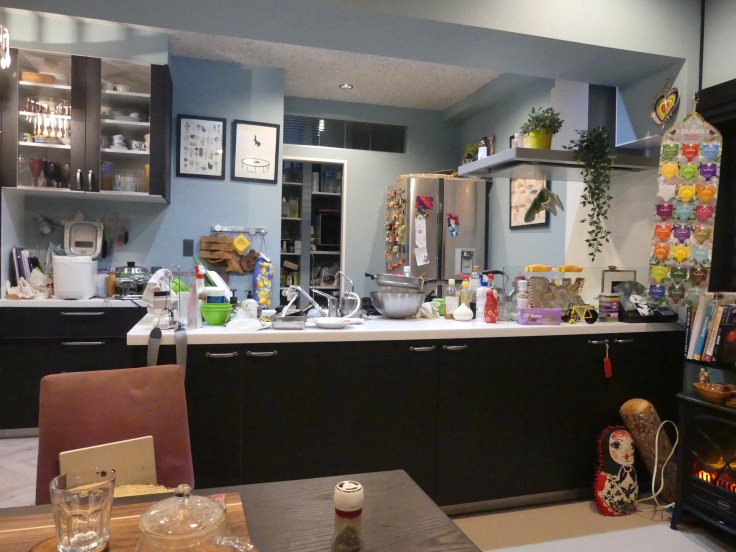 Our playground after 5 hours of cooking and eating.
Cooking with Nahoko was a great experience. I was alone and got lucky to experience a private class , so kind of her. The class felt relaxed , just like meeting with a friend , we had a really good time. I have learned more Japanese customs and language which is super interesting. It was not just a cooking class but also a cultural exchange. The food was very tasty and the ingredient of high quality (she will only use organic products). I can only recommend this class. We did a vegetarian class and the options provided were so yummy. Good recipes to bring back home for friends / family.
 free.cloud
Leave a comment